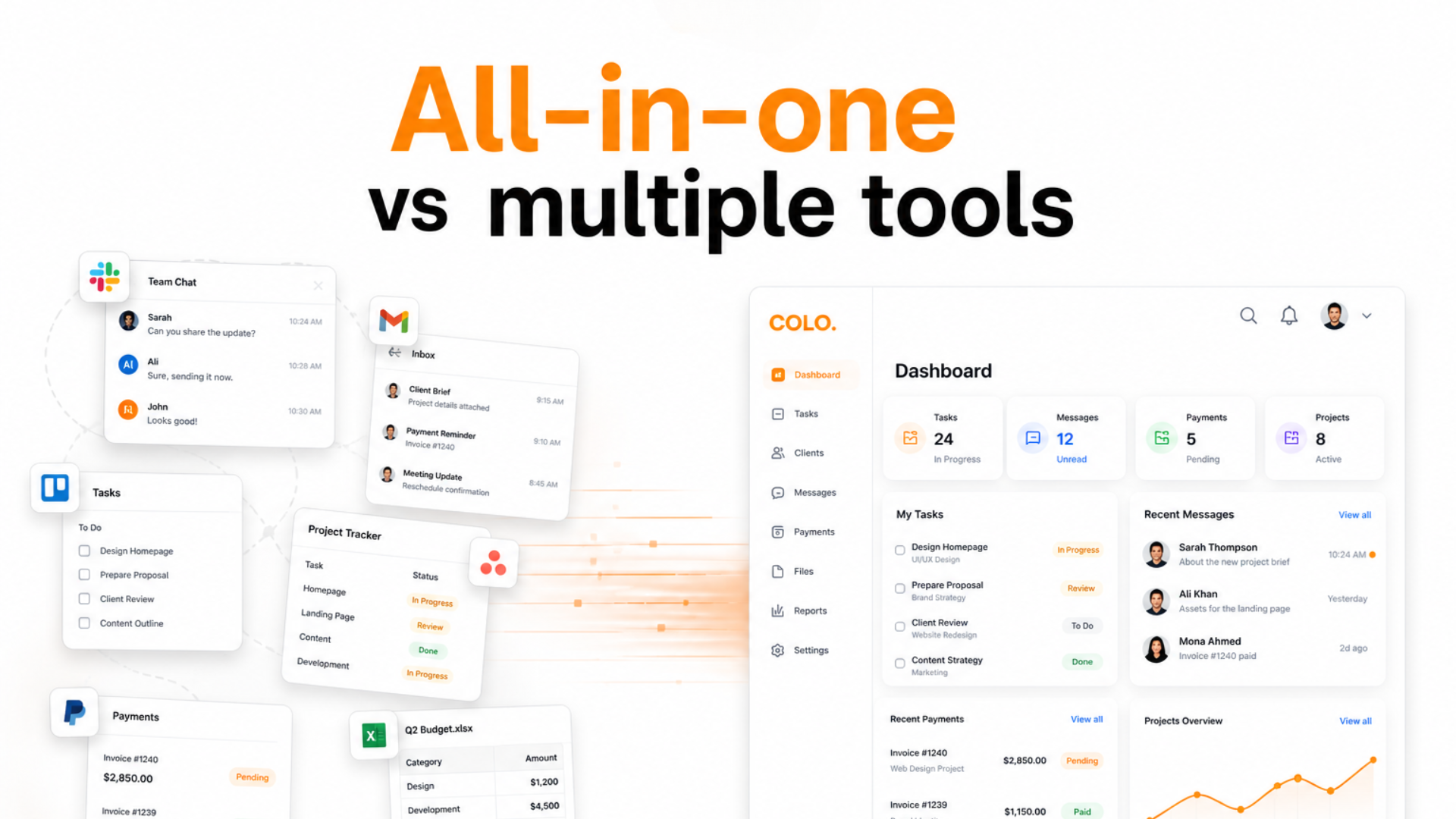
All in One vs Multiple Tools
Multiple tools each solve a problem well, but business operations are connected. When tools are not, work slows down and clarity disappears.
All in One vs Multiple Tools
Running a business today almost always means using multiple tools. You might be using one platform for communication, another for task management, something else for payments, and maybe a separate tool for tracking progress. At the beginning, this setup feels completely fine. Each tool does its job, and things seem manageable.
But as your work grows, this setup starts creating friction.
Information gets scattered across different platforms. You find yourself switching between tabs just to understand what is happening with a single client or project. A message comes in on one platform, the task is updated somewhere else, and the payment status is stored in another place. Over time, this constant switching slows everything down.
The Hidden Cost of Multiple Tools
The biggest issue with using multiple tools is not complexity. It is disconnection.
When your tools are not connected, your work is not connected either. You end up repeating the same actions across platforms. You read a message, then manually update a task. You check a payment, then send a reminder somewhere else. Nothing flows automatically.
This leads to small delays throughout the day. Individually, they seem minor. But together, they create a system where work takes longer than it should. Things get missed, follow ups are delayed, and clarity starts to disappear.
Instead of focusing on actual work, you spend more time managing where the work exists.
Why Multiple Tools Feel Powerful at First
There is a reason why people start with multiple tools. Each tool is built to solve a specific problem really well. A communication tool is great for conversations. A task manager is great for organizing work. A payment tool handles transactions efficiently.
Individually, they work perfectly.
But business operations are not isolated. Everything is connected. A client conversation leads to a task. A task leads to a deliverable. A deliverable leads to a payment. When these steps are handled in separate systems, the connection between them is lost.
That is when things start to feel messy, even if each tool is doing its job.
What Changes With an All in One System
An all in one system is not about having more features in one place. It is about connecting everything that already exists in your workflow.
Instead of jumping between tools, everything lives in a single system. Communication, tasks, payments, and tracking are all linked. When something changes, it updates across the system without extra effort.
You do not need to copy information from one place to another. You do not need to remember where things are stored. The system keeps everything organized and connected by default.
This reduces the need for manual coordination, which is where most inefficiencies come from.
Clarity is the Real Advantage
Most people assume that having more tools means being more organized. In reality, it often creates the opposite effect.
Clarity does not come from having more options. It comes from having everything in the right place.
When your work is inside one system, you can instantly see what is pending, what is completed, and what needs attention. There is no confusion about where to look or what to update.
This kind of clarity makes work faster, not because you are doing less, but because you are doing it in a more structured way.
Less Switching, Better Focus
Switching between tools might seem like a small thing, but it has a real impact on productivity. Every time you move from one platform to another, you lose context. You need a few seconds to reorient yourself, understand the screen, and continue working.
These small interruptions add up.
An all in one system removes this friction. You stay in one place, maintain your focus, and move through your work without constant interruptions. Over time, this leads to faster execution and better consistency.
Which Approach Makes More Sense
If your work is simple and limited, using multiple tools might still work for you. But as soon as you start managing multiple clients, tasks, and workflows together, the gaps between tools become more visible.
At that point, the problem is no longer about tools. It is about structure.
An all in one system provides that structure by bringing everything together.
Final Thought
The goal is not to use more tools. The goal is to make your work flow smoothly.
Multiple tools often create more movement but less clarity. An all in one system reduces that movement and replaces it with structure.
Because in the end, efficiency does not come from doing more things. It comes from doing the right things in the right system.