Best Workflow Systems for Growing Businesses
As businesses grow, managing daily operations becomes more complex. Discover the workflow systems that help growing businesses stay structured, efficient, and scalable.
Best Workflow Systems for Growing Businesses
As businesses grow, managing daily operations becomes more complex. What once worked with simple spreadsheets, emails, and scattered tools starts to create confusion.
Leads arrive from different channels. Projects multiply. Communication spreads across platforms. Invoices and payments require constant tracking.
Without a clear workflow system, these processes quickly become difficult to manage.
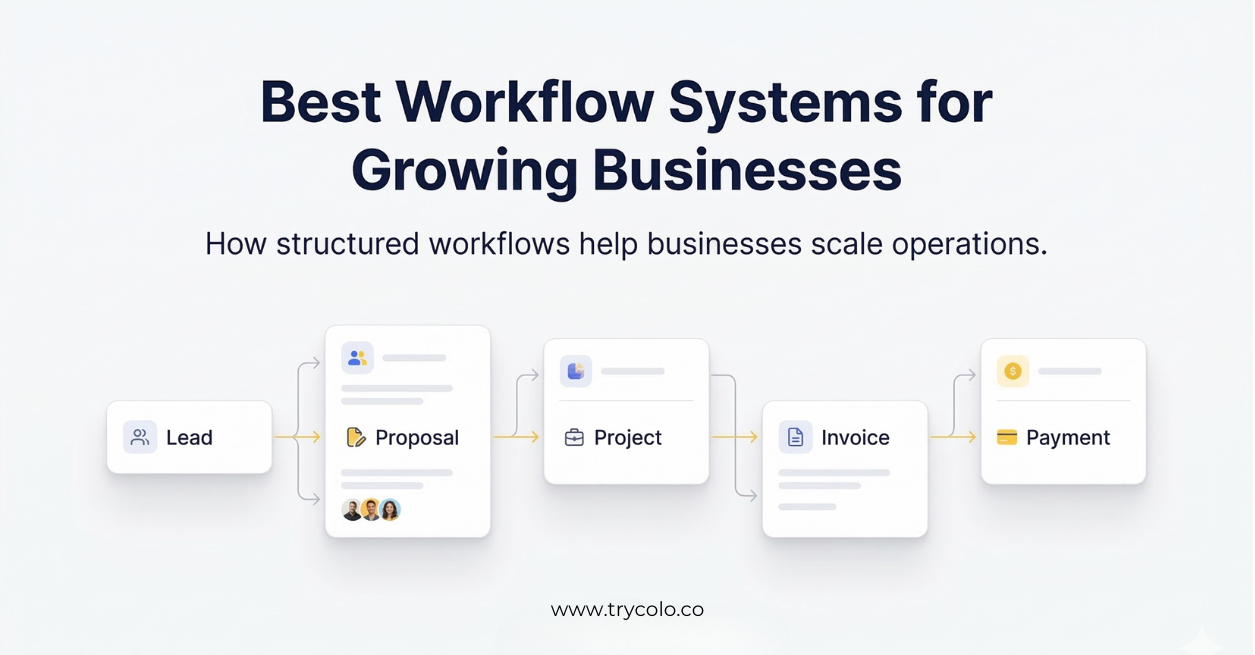
Growing businesses don't scale just by getting more clients. They scale by building systems that organize how work moves from the first inquiry to the final payment.
In this article, we explore the best workflow systems that help growing businesses stay structured, efficient, and scalable.
What Is a Workflow System?
A workflow system is a structured process that defines how work moves through a business.
Instead of relying on memory or disconnected tools, workflow systems create clear steps that guide tasks from start to completion.
Most service businesses follow a workflow that includes stages such as:
- Lead generation
- Client onboarding
- Project management
- Communication and collaboration
- Invoicing and payment collection
When these steps are clearly defined, teams know what to do, when to do it, and how work progresses.
Why Workflow Systems Matter for Growing Businesses
Many businesses operate without formal systems in the early stages. At first, this flexibility feels efficient. But as the number of clients and projects increases, the lack of structure becomes a problem.
Common issues businesses face without workflows include:
- Missed deadlines
- Unclear responsibilities
- Scattered communication
- Delayed payments
- Difficulty tracking project progress
Workflow systems solve these problems by creating predictable processes. They reduce confusion and help teams operate more efficiently.
When everyone understands the process, work moves faster and clients receive a more professional experience.
1. Lead-to-Client Workflow
One of the most important workflow systems for growing businesses is the lead management process.
Many businesses receive inquiries from email, social media, or website forms. Without a defined process, leads can easily be lost or forgotten.
A structured lead workflow typically includes:
- Lead inquiry
- Discovery conversation
- Proposal or quotation
- Client approval
- Project onboarding
This system ensures that every potential client moves through a clear process. It also improves response time and increases the chances of converting leads into paying clients.
2. Project Management Workflow
Once a client is onboarded, the next challenge is managing the project effectively.
Project workflows help teams organize tasks and ensure progress is consistent.
A typical project workflow includes:
- Project kickoff
- Task planning
- Milestone tracking
- Internal reviews
- Client feedback and approvals
This structure ensures that work is completed in the correct order and prevents confusion within teams.
Project workflows also improve transparency because everyone can see the current stage of work.
3. Communication Workflow
As businesses grow, communication often becomes fragmented. Messages may appear across email threads, messaging apps, project tools, and shared documents.
Without a defined communication system, important information can easily get lost.
Communication workflows help define:
- Where project discussions happen
- How updates are shared with clients
- How feedback is collected
- How decisions are documented
When communication follows a clear structure, teams spend less time searching for information and more time doing meaningful work.
4. Payment and Invoicing Workflow
One of the most overlooked workflow systems in growing businesses is payment management.
Many businesses rely on manual invoicing and reminders, which often leads to delayed payments and unnecessary follow-ups.
A strong payment workflow usually includes:
- Invoice creation
- Automated payment reminders
- Payment tracking
- Financial reporting
With a clear payment system, businesses can reduce delays and maintain healthier cash flow.
More importantly, professionals can stop spending time chasing payments and focus on delivering value to clients.
Building Workflow Systems with COLO
Managing multiple workflows across different tools can create new challenges. Businesses often end up juggling several platforms for tasks, communication, proposals, and payments.
This is where unified workflow platforms become valuable.
COLO helps businesses bring their operational workflows into one structured system. Instead of managing work across scattered tools, businesses can organize their processes in a single environment.
From client onboarding to project management and payment tracking, COLO enables teams to create workflows that are predictable and scalable.
By structuring operations in this way, businesses reduce chaos and build a foundation for sustainable growth.
Conclusion
Growth brings opportunity, but it also increases operational complexity.
Businesses that scale successfully are not necessarily the ones with the most clients or the biggest teams. They are the ones that build systems that keep their work organized.
Workflow systems help businesses manage leads, projects, communication, and payments in a structured way.
When these systems are clear and consistent, teams work more efficiently and clients experience smoother service.
For growing businesses, building strong workflow systems is not just helpful — it's essential.