From Side Hustle to Full Time Freelance: The Checklist
Going full time is a maths problem before it is a courage problem. Here is the checklist that tells you whether you are ready, in five phases you can work through in a weekend.
The wrong question
Most people about to leave a job for freelance work ask themselves some version of "am I good enough yet?" It feels like the important question. It is almost never the one that decides the outcome.
The freelancers who struggle in year one are rarely the least skilled. They are the ones who went full time with an unclear number, no contracts, no repeatable way of finding the next client, and a pipeline that looked healthy on the day they resigned and empty six weeks later. The transition is a maths and systems problem long before it is a talent problem.
This is the checklist. Five phases, in order, each with a test you either pass or you do not.
Phase 1 — Know the number
The test: you can state your monthly break-even figure to the nearest hundred, and your side-hustle income has covered it for three consecutive months.
Most people going full time compare their side income to their salary. That is the wrong comparison, twice over. Your salary came with employer contributions, paid leave, sick pay and possibly insurance; freelance revenue has to fund all of that out of the same pot. And your side income was earned in evenings and weekends, on top of a full-time job, which is not a rate you will sustain.
Work out three numbers before anything else:
- Personal break-even. What your household actually needs each month.
- Business overhead. Software, insurance, accountancy, equipment, workspace.
- The tax and buffer uplift. Set aside a defined percentage of every payment from day one, in a separate account. Confirm the percentage with an accountant for your jurisdiction — this is not a number to guess at.
Add them, then divide by the billable hours you can realistically sell — closer to 1,000 hours a year than 2,000 once admin, sales and holidays are removed. That is your real rate, and it is usually well above what side-hustlers charge. The freelance pricing guide works through the full calculation, and the freelance taxes and finance guide covers what to put aside and what to ask your accountant.
Also required: a cash runway of three to six months of personal break-even, sitting untouched. Not a credit limit. Cash.
Phase 2 — Prove the pipeline, not the income
The test: you can name where your next three clients will come from, without using the word "referrals" as the whole answer.
A side hustle survives on whatever arrives. A business needs a source. Before you resign, write down the actual mechanism behind your last five clients — a former colleague, a specific community, a marketplace, one particular introducer — and identify which of those you can deliberately repeat.
Then check the shape of your revenue. Three clients at equal value is a business; one client at seventy percent of revenue is a job with worse protection. If a single client dominates, spend the pre-resignation months diversifying rather than optimising.
Finally, be honest about capacity. Going full time means roughly two and a half times the available hours, not five times, because a large share of the new time goes to work you were not doing before: proposals, invoicing, chasing, admin, marketing. Plan for it.
Phase 3 — Get the paperwork real
The test: every active client has a signed contract, and you have a proposal you can send in under thirty minutes.
Side hustles run on goodwill and email threads. That works until it does not, and the failure — an unpaid invoice, a scope dispute, a client who disappears after delivery — lands much harder when the income is not optional.
Before you go full time, put four documents in place:
- A proposal you can adapt quickly, covering scope, price, timeline and what is excluded. Start from the freelance proposal template.
- A contract you actually send, with payment terms, a deposit, a late-payment clause, a change-request clause and IP ownership. The service contract template is a working baseline, and the freelance contracts guide explains which clauses earn their place.
- A scope document per project, so "one more small change" has somewhere to be measured against. Use the creative brief template for creative work or the consulting statement of work template for advisory work.
- An invoice with real terms on it, numbered sequentially, with a due date and a payment link. The freelance invoice template covers the required fields.
Take a deposit on signature. Thirty to fifty percent is standard for project work, and it is the single most effective protection against the client who goes quiet.
Phase 4 — Build the system before you need it
The test: you can answer "what is the status of every client right now?" in under two minutes, without opening your inbox.
At two clients, memory is a system. At six, it is a liability. The transition to full time roughly triples the number of moving parts, and the failure mode is not dramatic — it is a missed follow-up, an invoice sent three weeks late, a deliverable the client swears was agreed differently.
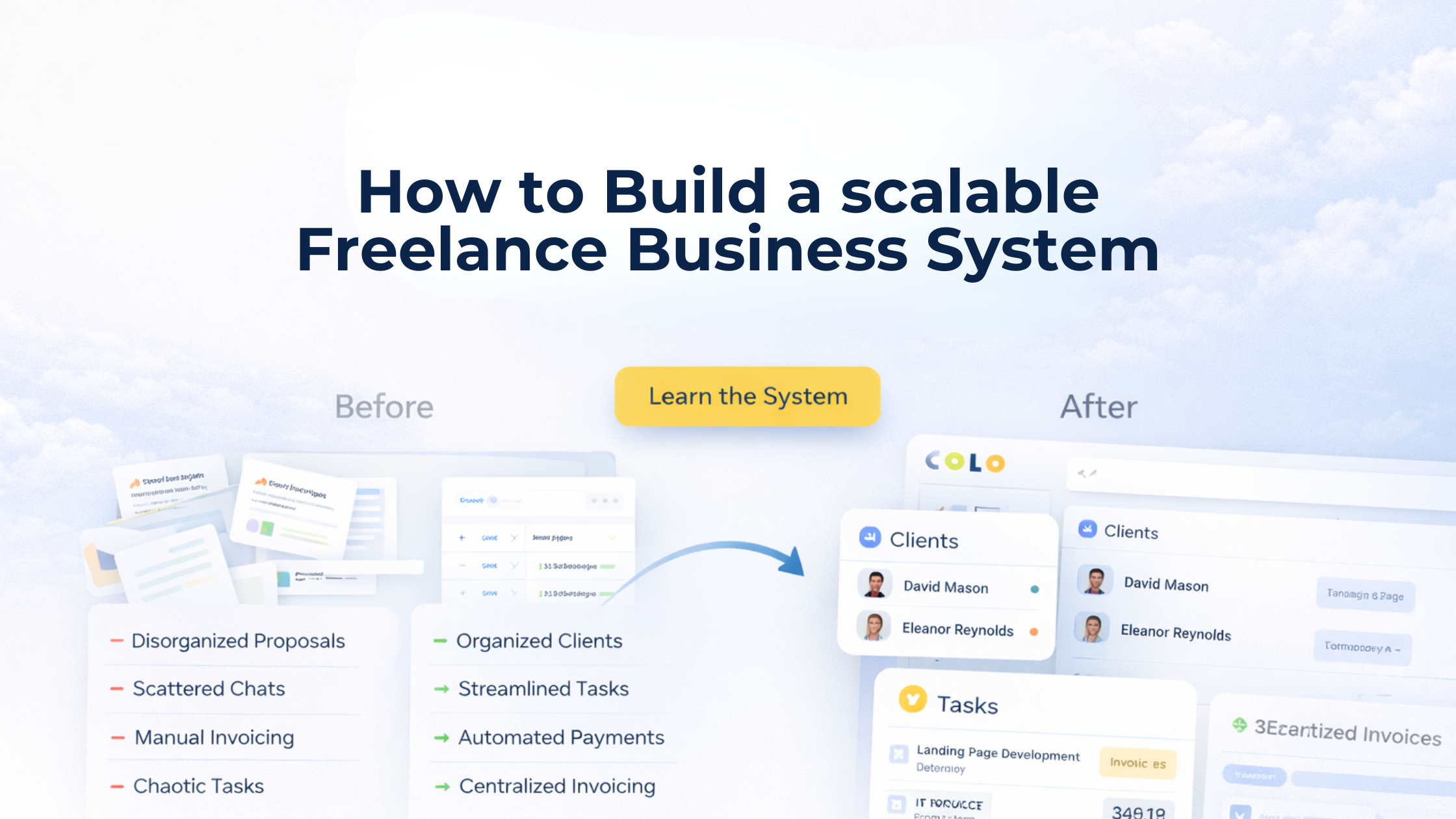
The minimum viable system is one place where each client's work, documents and money live together: the accepted proposal, the signed contract, the live project with tasks and deadlines, the messages, and the invoices raised against it. Add a client portal and most status-update emails stop arriving, because the client can see the answer themselves.
Two habits matter more than the tool you choose. First, track time from day one even on fixed-price work — it is the only way to learn which projects are actually profitable, and reports and finance turn that into a rate decision at your next quote. Second, standardise onboarding, so client seven gets the same experience as client one. The client onboarding guide and its checklist cover the sequence.
Do this while you still have a salary. Building a workflow under revenue pressure is how people end up back where they started.
Phase 5 — Time the exit
The test: you have a date, a notice plan, and nothing in your employment contract that blocks the work you intend to do.
Read your employment contract properly — not the summary you remember. Look for exclusivity, IP assignment, non-compete and non-solicit clauses, and check whether any current side clients would breach them. If in doubt, get an hour of legal advice; it is cheaper than the alternative.
Then leave well. Give proper notice, hand over cleanly, do not poach unless your contract clearly permits it. Former employers and colleagues are a meaningful source of freelance work, and the transition is not the moment to spend that goodwill.
Pick the date deliberately. Going full time immediately before a known quiet season in your market is an avoidable handicap.
The checklist, in one place
- Break-even, overhead and tax-set-aside percentage calculated
- Three consecutive months of side income covering break-even
- Three to six months of cash runway, untouched
- Real rate calculated against ~1,000 billable hours
- Named source for the next three clients
- No single client above roughly half of revenue
- Proposal, contract, scope document and invoice ready to send
- Deposit terms decided and written into the contract
- One system holding clients, projects, documents and money
- Onboarding standardised and repeatable
- Employment contract checked for exclusivity and non-compete
- Notice given properly, with a chosen start date
If you can tick all twelve, the remaining risk is ordinary business risk rather than avoidable self-inflicted risk. If you cannot, the gaps are your to-do list — and each of them is easier to close while you still have a salary funding the effort.
For the fuller picture once you are running, the freelance business management guide covers the whole operating model, getting paid as a freelancer covers cash flow, and the solo to agency scaling guide covers what happens when you outgrow yourself.