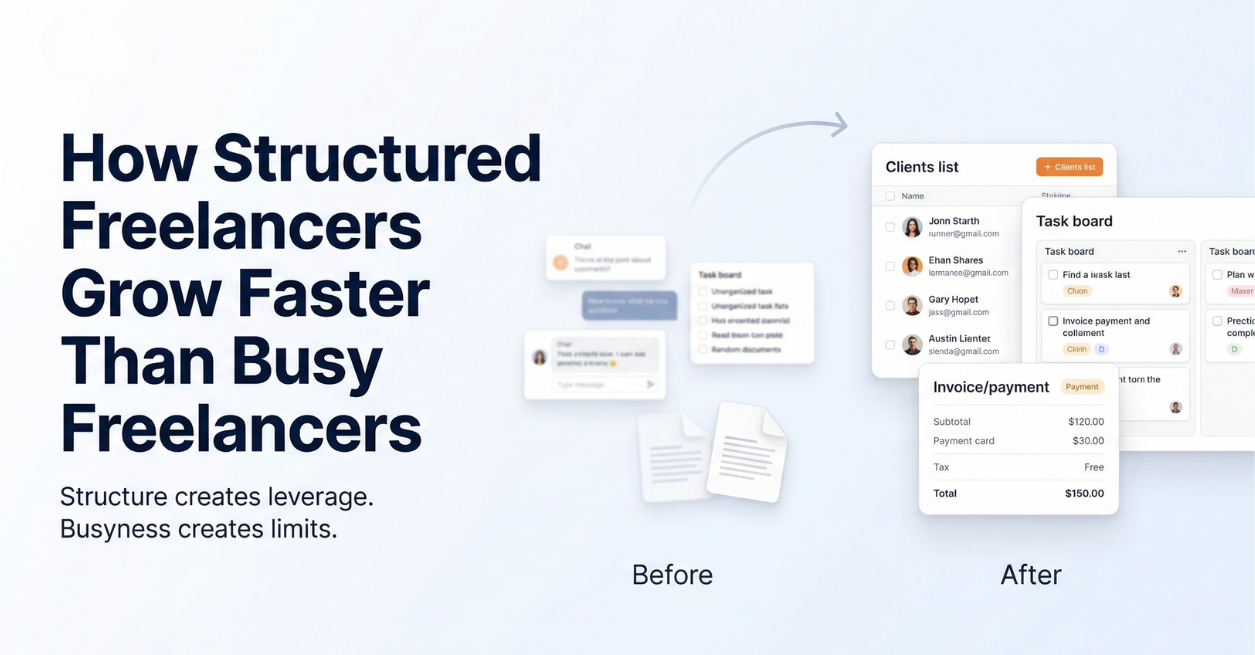
How Structured Freelancers Grow Faster Than Busy Freelancers
Freelancing often starts with doing everything — finding clients, managing projects, handling communication, tracking payments. But busyness alone is not growth.
How Structured Freelancers Grow Faster Than Busy Freelancers
Freelancing often starts with doing everything. Finding clients. Managing projects. Handling communication. Tracking payments.
At the beginning, being busy feels like progress. More work. More clients. More activity.
But over time, busyness becomes a bottleneck.
Busy Doesn't Mean Scalable
Many freelancers stay busy but don't grow. Their days are filled with tasks, but their business doesn't move forward.
Projects overlap. Deadlines get tighter. Communication becomes scattered. Everything depends on them.
This is the difference between working in your business and building your business.
Busyness keeps you occupied. Structure helps you scale.
The Problem With Unstructured Freelancing
When there is no system, every project starts from scratch.
Client details are scattered across chats. Proposals are rewritten every time. Tasks live in different places. Payments are tracked manually.
This creates friction at every step. As the number of clients increases, complexity increases faster. And eventually, growth slows down.
Not because of lack of skill. But because of lack of structure.
What Structured Freelancers Do Differently
Structured freelancers don't rely on memory or effort. They rely on systems.
Instead of reacting to work, they design how work flows. Every part of their business follows a defined process.
Client onboarding is clear. Proposals follow a structure. Tasks are organized. Payments are tracked systematically.
This reduces confusion and creates consistency.
The Power of Repeatable Systems
A structured freelance business is built on repeatability. Instead of solving the same problems again and again, systems handle them.
A typical structured workflow looks like:
Client inquiry → Proposal → Agreement → Execution → Delivery → Payment
Each step is predefined. This allows freelancers to:
- Start projects faster
- Reduce decision fatigue
- Avoid missed details
- Deliver consistently
When processes are repeatable, growth becomes manageable.
Why Structure Leads to Faster Growth
Growth is not just about getting more clients. It's about handling more work without losing control.
Structured freelancers can take on more projects because:
- Their workflow is organized
- Their communication is clear
- Their operations are predictable
They don't spend time figuring out what to do next. They follow a system. This efficiency creates space for growth.
The Hidden Cost of Staying Busy
Busy freelancers often reach a limit. They can't take on more work without increasing stress.
They start missing deadlines. Quality drops. Client experience suffers. Eventually, growth stops.
Not because demand isn't there. But because the system can't support it.
Building a Structured Freelance System
Moving from busy to structured doesn't require complexity. It requires clarity.
Start by defining your core workflow:
- How do clients reach you?
- How do you send proposals?
- How do you manage tasks?
- How do you track payments?
Then bring these steps into a connected system. When everything works together, your business becomes easier to manage.
Final Thoughts
Freelancing rewards effort at the beginning. But it rewards structure in the long run.
Busy freelancers stay occupied. Structured freelancers build leverage.
The goal is not to do more work. The goal is to build a system that can handle more work without you.