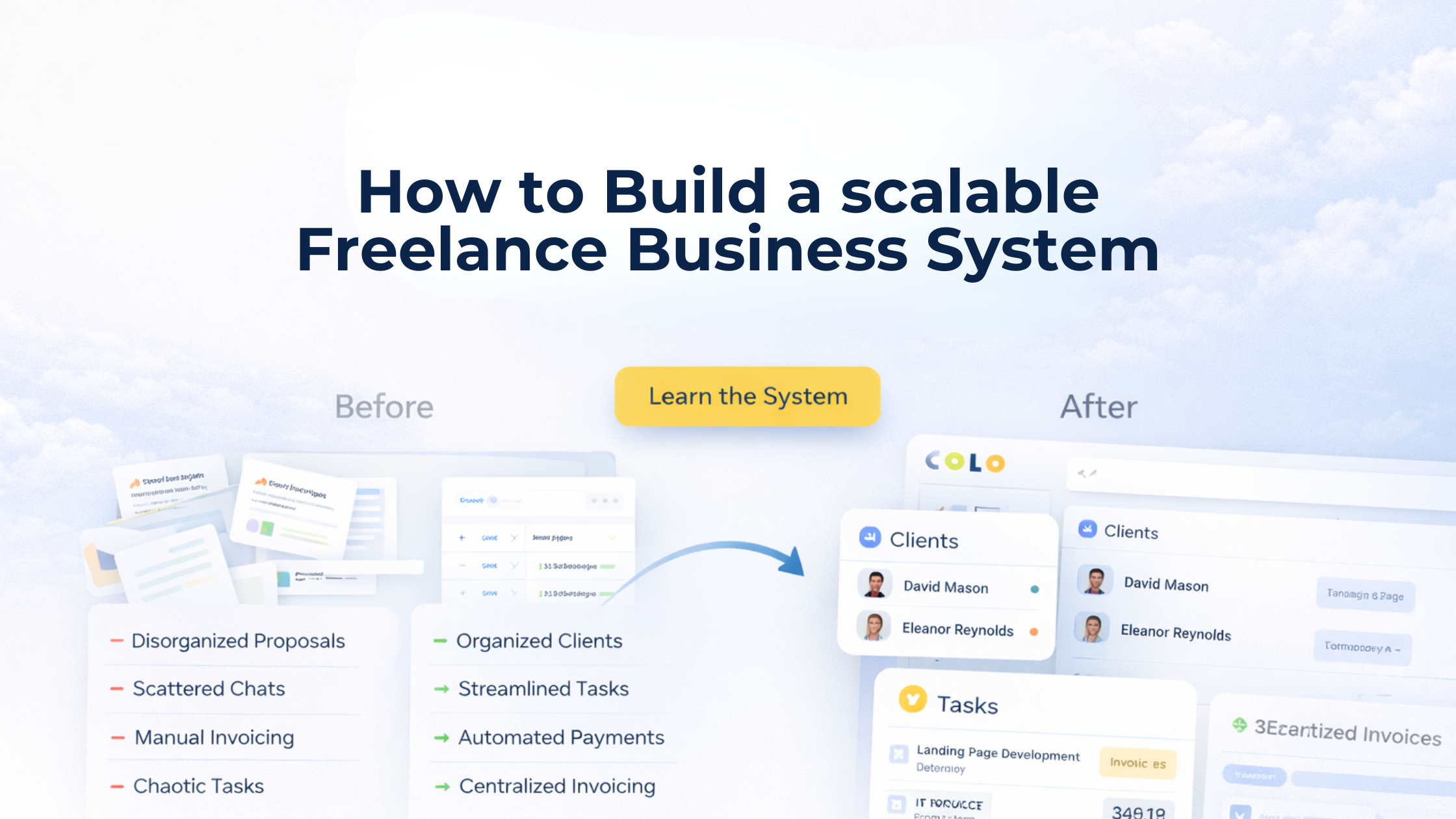
How to Build a Scalable Freelance Business System
Freelancing often starts with freedom. One client, a few projects, and the flexibility to work on your own terms.
How to Build a Scalable Freelance Business System
Freelancing often starts with freedom. One client, a few projects, and the flexibility to work on your own terms.
But as more clients come in, the same freedom can quickly turn into chaos. Proposals in documents. Client messages on WhatsApp. Tasks in a notebook. Invoices in another tool. Payments tracked manually.
What began as a simple freelance setup slowly becomes a scattered system that is difficult to scale.
The freelancers who successfully grow their business are not necessarily the most talented. They are the ones who build systems that allow them to handle more work without losing control.
A scalable freelance business is not about working harder. It is about creating a structured workflow that manages your projects, clients, and finances efficiently.
The Difference Between Freelancing and Running a Freelance Business
Many freelancers operate project by project. Every new client requires starting the process again from scratch.
Messages need to be searched. Files get lost. Payments are followed up manually. This works when you have two or three clients. It breaks when you have ten.
A freelance business operates differently. It follows a repeatable system that manages the entire client lifecycle.
From the moment a client contacts you to the moment you receive payment, every step is organized.
This structure is what allows freelancers to scale their work without increasing stress.
The Core Components of a Scalable Freelance System
A scalable freelance business usually relies on a few key systems that keep operations structured and predictable.
1. Client Management
As your client list grows, keeping track of conversations, project details, and expectations becomes difficult.
A proper client management system helps you keep everything organized in one place.
Instead of searching through multiple chat threads or emails, you can track client information, communication history, and project progress within a single workspace.
This clarity improves professionalism and helps build stronger client relationships.
2. Proposal and Contract Workflow
Many freelancers lose time repeatedly writing proposals or clarifying project terms.
A structured proposal and contract process simplifies the start of every project. Proposals clearly communicate the scope of work, deliverables, and pricing. Contracts protect both you and the client by defining expectations from the beginning.
When these steps are streamlined, new projects can start faster and with fewer misunderstandings.
3. Task and Project Management
Projects often fail not because of poor skills, but because of poor organization. When tasks are tracked properly, deadlines become easier to manage and progress becomes visible.
A clear task system helps you:
    1- Break projects into manageable steps


    2- Assign priorities


    3- Track deadlines


    4- Monitor progress
This visibility ensures that projects move forward without confusion.
4. Calendar and Time Visibility
Freelancers often underestimate how quickly their schedule fills up.
Without proper calendar management, it becomes easy to overcommit and miss deadlines.
A centralized calendar allows you to track meetings, project milestones, and delivery timelines in one place.
This makes planning easier and prevents workload conflicts.
5. Financial Tracking
Many freelancers manage their finances manually through spreadsheets or scattered payment records.
As your business grows, this approach becomes inefficient.
Tracking invoices, payments, expenses, and income through a financial system provides a clear picture of your business performance.
It also helps maintain professionalism when working with clients.
Why Most Freelancers Struggle to Scale
The biggest challenge freelancers face is not finding clients. It is managing the work that comes after.
The more successful you become, the more complexity you introduce into your workflow.
More projects. More communication. More payments to track.
Without a structured system, growth leads to stress instead of opportunity. Freelancers who scale successfully focus on building a workflow that connects every part of their business.
Building a System That Works
A scalable freelance system connects the entire workflow:
Client inquiry → Proposal → Contract → Tasks → Communication → Payment.
When these steps live in separate tools, the process becomes fragmented.
When they exist in one connected system, the entire workflow becomes easier to manage.
Instead of spending time organizing your work, you can focus on delivering it.
Final Thoughts
Freelancing gives you independence, but independence alone does not create a sustainable business.
To scale successfully, freelancers need systems that manage their operations efficiently.
Client management, structured proposals, task organization, scheduling, and financial tracking are the foundations of a scalable freelance business.
When these systems work together, growth becomes manageable rather than overwhelming.
A well-organized workflow does more than save time. It allows freelancers to focus on what actually matters: delivering great work and building lasting client relationships.
Ready to Try It?
A free day pass is the lowest-risk experiment in business. Sign up and book a desk — no credit card required, no commitment.