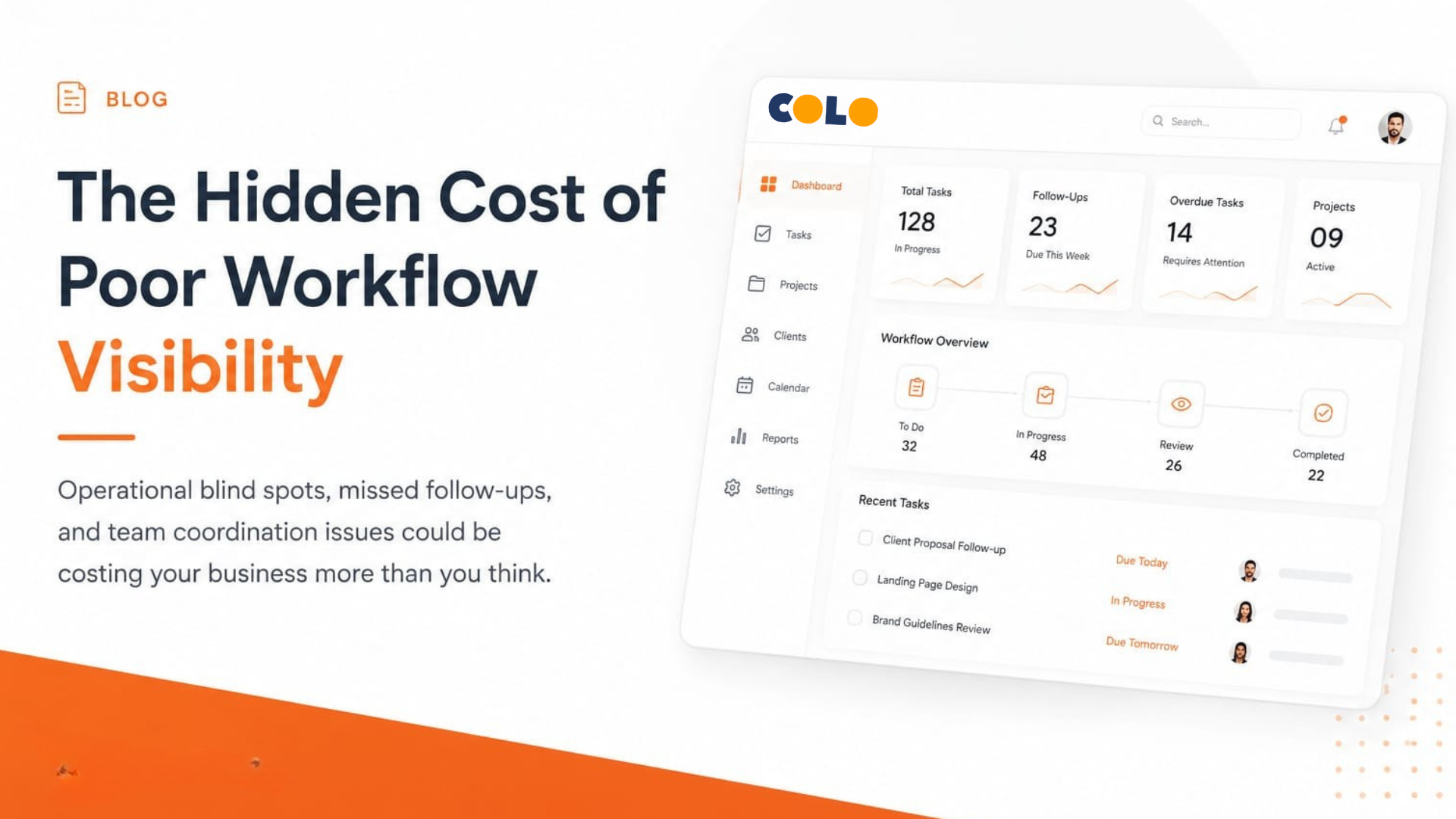
The Hidden Cost of Poor Workflow Visibility in Small Businesses
Small businesses focus on sales and marketing, but the real bottleneck to scale is often invisible: scattered workflows that quietly cost productivity, clients, and revenue.
The Hidden Cost of Poor Workflow Visibility in Small Businesses
Small businesses often focus heavily on sales, marketing, and client acquisition. But one of the biggest reasons businesses struggle to scale is something less visible:
Poor workflow visibility.
When tasks, communication, follow-ups, and responsibilities are scattered across multiple tools and conversations, businesses lose operational clarity. Over time, this creates delays, missed opportunities, team confusion, and slower growth.
For modern small businesses, workflow visibility is no longer optional. It directly affects productivity, client experience, and long-term scalability.
What Is Workflow Visibility?
Workflow visibility means having a clear understanding of:
- ongoing tasks
- team responsibilities
- client progress
- pending approvals
- follow-ups
- deadlines
- operational bottlenecks
In simple terms, it means knowing what is happening inside the business at all times.
Many small businesses operate without centralized visibility systems. Information gets spread across:
- WhatsApp chats
- emails
- spreadsheets
- project management tools
- sticky notes
- personal reminders
At first, this may seem manageable. But as operations grow, the lack of visibility becomes expensive.
The Hidden Operational Costs of Poor Workflow Visibility
Most businesses don't immediately notice workflow problems because the damage happens slowly over time.
Here are some of the biggest hidden costs.
1. Missed Follow-Ups
One of the most common operational problems in small businesses is inconsistent follow-ups.
Without workflow visibility:
- leads get forgotten
- client replies are delayed
- approvals remain pending
- important tasks slip through the cracks
This directly impacts:
- conversions
- client retention
- trust
- customer experience
For agencies and freelancers, missed follow-ups can easily become lost revenue.
2. Team Coordination Problems
As teams grow, communication becomes harder to manage.
Without centralized workflows:
- responsibilities become unclear
- tasks overlap
- updates get missed
- team members work in silos
This creates operational confusion.
Instead of focusing on execution, teams spend time asking:
- "Who is handling this?"
- "Was this completed?"
- "Did the client approve this?"
- "Where was this discussed?"
Poor coordination slows down execution speed significantly.
3. Reduced Productivity
Many businesses assume productivity problems are caused by employees.
In reality, operational systems are often the real issue.
When workflows are scattered:
- employees constantly switch between tools
- information becomes difficult to locate
- priorities become unclear
- execution becomes reactive instead of structured
This creates hidden inefficiency across the business. Teams appear busy all day but accomplish less meaningful work.
4. Lack of Business Visibility
Small business owners often struggle because they cannot clearly see:
- operational progress
- bottlenecks
- team performance
- pending tasks
- workflow status
Without visibility, decision-making becomes reactive. Problems are discovered too late instead of being prevented early.
This is one of the biggest reasons scaling becomes difficult for growing businesses.
5. Client Experience Suffers
Clients notice operational inefficiencies quickly.
Poor workflow visibility often leads to:
- delayed responses
- inconsistent communication
- missed deadlines
- unclear updates
- repeated requests for information
Even strong businesses lose credibility when operations feel disorganized. In competitive markets, operational experience becomes part of the product itself.
Why Workflow Visibility Matters More as Businesses Scale
Small workflow problems become larger operational problems over time.
A freelancer managing 3 clients may survive with scattered systems.
An agency managing:
- multiple clients
- team members
- projects
- approvals
- deadlines
cannot scale efficiently without centralized workflow visibility.
As operations grow:
- complexity increases
- communication expands
- dependencies multiply
Without structure, businesses become harder to manage internally.
The Shift Toward Centralized Operations
Modern businesses are moving away from fragmented workflows.
Instead of using disconnected systems for every process, businesses are increasingly adopting centralized operational platforms that combine:
- workflows
- task management
- communication
- follow-ups
- client operations
- visibility systems
The goal is not simply "using fewer tools." The goal is creating operational clarity.
When workflows become centralized:
- teams stay aligned
- follow-ups improve
- execution becomes faster
- bottlenecks become visible
- businesses scale more predictably
Signs Your Business Has Workflow Visibility Problems
Many small businesses already experience workflow visibility issues without realizing it.
Common signs include:
- constantly asking for updates
- missed deadlines
- scattered communication
- repeated client follow-ups
- unclear task ownership
- operational confusion
- too many disconnected tools
- difficulty tracking progress
If these problems happen regularly, the issue is often operational visibility rather than productivity itself.
How Small Businesses Can Improve Workflow Visibility
Improving workflow visibility starts with simplifying operations.
Key steps include:
- centralizing communication
- organizing workflows
- creating clearer task ownership
- reducing scattered systems
- improving follow-up tracking
- increasing operational transparency
The businesses that scale effectively are usually not the businesses with the most tools. They are the businesses with the clearest operational systems.
Final Thoughts
Poor workflow visibility creates hidden operational costs that affect:
- productivity
- client experience
- team coordination
- scalability
- revenue growth
For small businesses, freelancers, and agencies, operational clarity is becoming a major competitive advantage.
Because as businesses grow, execution becomes harder without visibility.
And eventually, the businesses with the cleanest systems move faster than the businesses with the most software.